Why I Used the Seven Deadly Sins to Build an AI Ethics Tool for Project Managers
There is no shortage of AI ethics guidance. Frameworks, principles, policy documents, training modules — the field is producing them at pace.
And yet, when I looked at what was available for project managers specifically, I kept finding the same problem: the guidance was abstract, issue-driven, and written for organisations rather than individuals.
I wanted something different.
I wanted a tool that would produce a personal commitment document — something a project manager could walk away with and actually use.
To build it, I turned to a framework that is over a thousand years old.
The Problem With Generic AI Ethics Guidance
Most AI ethics content follows a familiar pattern. It identifies an issue — power consumption, bias, data privacy, job displacement — and then opens a debate about that issue.
That is a legitimate way to approach ethics.
It is also largely useless for a project manager sitting in front of a generative AI tool on a Tuesday afternoon, trying to decide what is and isn't appropriate to do with it.
Generic guidance doesn't stick because it isn't personal. It tells you what the issues are. It doesn't ask you what you do, what risks your practice carries, or what commitments you are willing to make and be held to.
It treats ethics as a topic to be understood rather than a practice to be owned.
Project managers work in high-stakes, high-pressure environments where AI is being adopted fast and governed slowly.
They need an ethics framework that fits how they actually work — not one designed for policy committees or technology companies.
Why the Seven Deadly Sins
When I started designing the framework, I needed categories that were simple, memorable, and capable of carrying real weight.
I also needed them to map cleanly onto the actual failure modes I was seeing in AI use: overconfidence in outputs, data misuse, over-reliance, misrepresentation, purposeless generation, harm diffusion, and intellectual abdication.
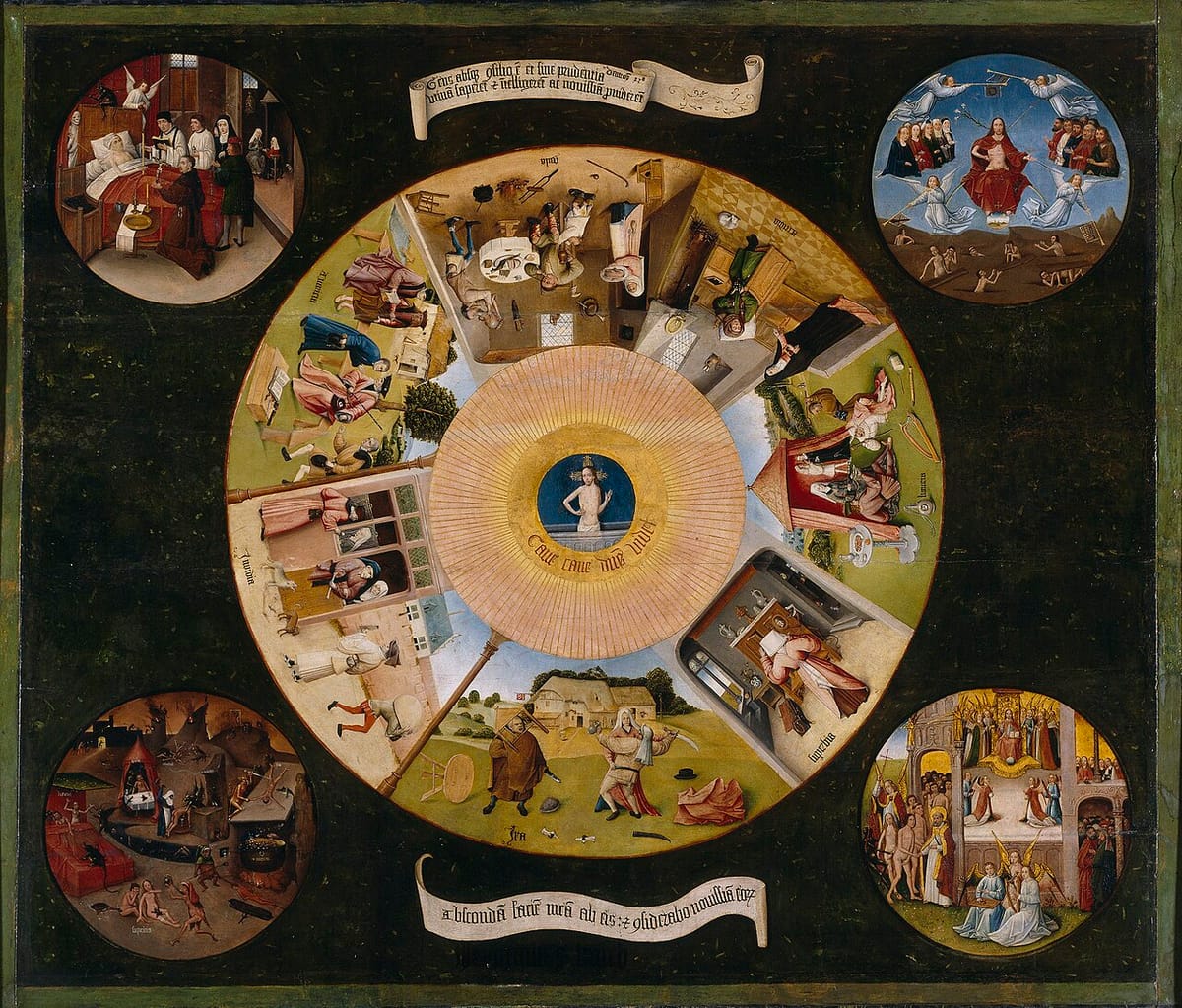
The Seven Deadly Sins — Pride, Greed, Lust, Envy, Gluttony, Wrath, Sloth — map onto those failure modes with uncomfortable precision.
I anticipated the obvious objection.This is a framework with religious origins.
Some people will reject it on those grounds.
My argument is this: the Seven Deadly Sins, while grounded in a theological context, are used everywhere. Every significant piece of literature explores them. Every film that examines human failure circles back to them.
We recognize them because we have all experienced them, in ourselves and in others.
That recognition is exactly what makes them useful here.
Let's quickly examine the book Wuthering Heights.
- Pride — Heathcliff's entire arc is driven by wounded pride; humiliated as a nameless orphan, he spends decades engineering revenge rather than ever accepting his lowly origins.
- Greed — Heathcliff systematically acquires both Wuthering Heights and Thrushcross Grange through manipulation and legal cunning, treating property as a weapon of dominance rather than a means of comfort.
- Lust — Catherine and Heathcliff's bond burns with an obsessive, consuming passion that refuses to obey the boundaries of marriage, class, or even death.
- Envy — Heathcliff envies Edgar Linton not merely for winning Catherine, but for the breeding, wealth, and social legitimacy that were never available to him as a foundling.
- Gluttony — After Catherine's death, Heathcliff indulges his grief without restraint, starving himself and courting death in an almost addictive surrender to suffering and memory.
- Sloth — Hindley Earnshaw wastes his inheritance, his fatherhood, and ultimately his life in drunken dissolution after his wife's death, surrendering every responsibility he was born into.
- Wrath — Wrath is perhaps the novel's most dominant sin; Heathcliff's wrath is generational, cold, and methodical — extending punishment not just to his enemies but to their innocent children.
One of the most popular books (and movies), touches on all seven themes of the deadly sins. The sins are universal.
It is a framework that is applicable and accessible to all of us.
The Case for Moral Language
There is another reason I chose this framework, and it is worth stating directly.
We have largely stopped using moral language when we talk about AI.
We talk about ethics, but we mean issues. We debate power consumption, regulatory compliance, algorithmic fairness. These are important conversations.
But they are grounded in problems, not in moral weight.
Moral language asks something different of us.
It doesn't just ask whether something is efficient or compliant or defensible. It asks whether it is right.
It creates a different kind of accountability — one that sits with the individual, not the organization.
When I call one failure mode Pride — the overconfidence that leads a project manager to accept AI-generated outputs without verification — I am not just describing a process risk. I am naming something the project manager already knows about themselves.
The language creates a moment of recognition that technical terminology does not.
That recognition is the point. Ethics without recognition doesn't change behavior.
What the Tool Actually Does
The Personal AI Ethics Charter Builder is a structured facilitation prompt.
It guides a project manager through seven diagnostic categories — one for each sin — asking targeted questions grounded in their specific AI usage, their professional context, and their own stated practices.
It does not lecture. It does not produce generic output. It does not advance until the user has genuinely engaged with each category and confirmed their own reflection.
At the end of the session, it produces a single document: a personal AI ethics charter written in first-person declarative language. Not "organisations should..." but "I will...", "I commit to...", "I take responsibility for..."
The document belongs to the person who created it. It reflects their practice, their risks, and their commitments — not a template someone else filled in on their behalf.
A Note on the Framework's Limits
The sins are diagnostic lenses, not moral judgments. The tool is explicit about this.
A project manager working through the Greed category is not being accused of wrongdoing — they are being asked to examine whether their AI use respects data sovereignty and the privacy of the people their projects affect.
The language is intentionally provocative. That is a feature, not a flaw. If the framework makes you slightly uncomfortable, it is doing its job. Comfort is not the goal. Honest reflection is.
AI ethics for project managers needs to be personal, practical, and grounded in language that carries weight. The Seven Deadly Sins, for all their antiquity, turn out to be a remarkably precise instrument for that purpose.
The framework is old. The problem it is being applied to is new. That tension is, I think, exactly right.
Accessing the Tool
I offer the tool two ways.
First, as a Claude Artifact.
Second, thru Poe.com
If you access it thru Claude you will need a Claude account.
If you access it thru Poe you will need a Poe account.
What is Poe you ask? Online portal where people have access to multiple LLMs at their fingertips. One account, multiple LLMs.
One other note: I don't see your conversation with the tool. The tool is served up either via Claude or Poe. The conversation remains within your account.
Here are the links:
Claude:
https://claude.ai/public/artifacts/96dcf7f1-7e34-4a68-9bb1-3207ee15238b
Poe:

Personal AI Ethics Charter - Poe.com
I would really appreciate your feedback on this tool. Please contact me with your thoughts.
Get Intentional,
Paul
P.S. Here is my own AI Ethics Charter. May be helpful to you to see the output before you engage with the tool.